
Start with a comfortable setup and a controlled half swing. Your first goal is to contact the ball and finish in balance with a motion you can repeat. Choose a short or middle iron that feels manageable, select a target, and give yourself room to swing safely.
Work on one change at a time. If you adjust your grip, stance, and swing speed together, you will struggle to tell which change helped.
Build a setup you can repeat
Aim the clubface toward your target first, using a nearby spot on that line as a reference. Then arrange your feet roughly parallel to the target line. Your feet should support your balance without making you feel stretched or cramped.
Place both hands together on the handle. For a right-handed swing, the left hand sits above the right; reverse that arrangement for a left-handed swing. Hold securely enough to control the club while allowing your wrists and arms to move.
Tip forward from your hips, soften your knees, and let your arms hang comfortably. Adjust your stance, grip thickness, and swing length to your movement and comfort, regardless of gender. If reaching the ball requires an awkward posture, ask a qualified instructor or fitter to check the club’s suitability.
Follow the motion from takeaway to finish
The takeaway—the opening movement of the backswing—starts the club away from the ball. Let your arms and chest move together as your body turns. Allow the club to rise without chasing a prescribed height or forcing a bigger shoulder turn.
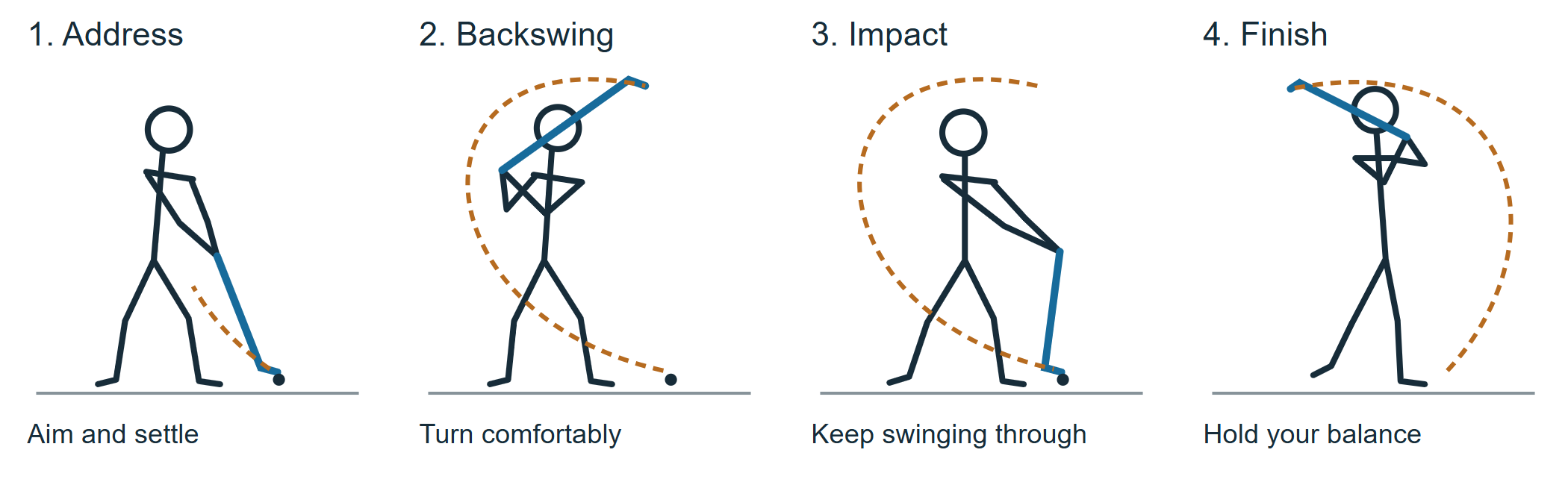
Begin the transition back toward the ball smoothly. Feel support move toward your lead foot—the foot nearer the target—while your body turns and your arms swing down. Avoid a sudden tug with your hands.
Continue through contact instead of trying to stop at the ball or scoop it upward. Let the club travel into a finish you can hold comfortably, with most of your support on your lead leg. The finish gives you useful feedback about the motion that came before it.
Use a safe half-swing checkpoint
Teaching example: On a practice range, check that nobody is within reach of your club. Make a comfortable rehearsal with your hands traveling about waist high on either side. The height is a guide; shorten the motion if necessary. Stop if movement causes pain.
Hit three balls at an easy pace. After each swing, hold your finish for two counts. Notice whether you contacted the ball, where it started, and whether you stayed balanced. Choose one adjustment for the next three balls, such as easing your grip pressure. Keep the other prompts unchanged so the comparison means something.
Read a mishit before choosing a correction
| Checkpoint | What to observe | First response |
|---|---|---|
| Setup | Clubface aim, comfortable reach, and steady footing. | Reset before changing your swing. |
| Contact | Whether the strike feels solid and whether the club hits the ground before the ball. | Reduce swing length and observe another small group. |
| Finish | Whether you can hold your position without stepping or falling backward. | Try less speed and check your starting balance. |
A mishit rarely identifies its own cause. Ground contact before the ball can involve setup, balance, or changes in how your arms and body move. A ball starting right can reflect clubface direction and the direction the club travels. One result does not prove one fault. Look for a repeated pattern before making another change, and use an instructor’s observation when the pattern remains unclear.
Build the motion around the person
Expand from half swings toward a fuller motion when contact and balance become reasonably repeatable. Add length before chasing speed, and return to the shorter swing when control becomes difficult. Flexibility, strength, experience, and comfort matter more than gender-based instructions.
These basics provide a shared foundation across clubs. For your next step, study driver tee setup or iron low point—the lowest part of the clubhead’s arc—in the relevant club-specific instruction.