
Good golf course strategy starts with the shot you want next. On a par 4 with trouble across the direct route, choose the wider landing area when it leaves an open approach and your ordinary carry does not comfortably clear the trouble. The shorter route becomes an option when the required shot fits your usual results, today’s lie, and the wind.
Work backward from the green: identify a useful approach angle, find a landing area that provides it, then choose a club whose usual misses leave a manageable next shot.
Map the hole backward from the green
Our hypothetical par 4 has a red penalty area across the aggressive line, a separate white out-of-bounds edge on the right, and a bunker in front of the green. The wide left landing area leaves an open approach around the bunker. Cutting across the red area shortens the hole but demands a reliable carry.
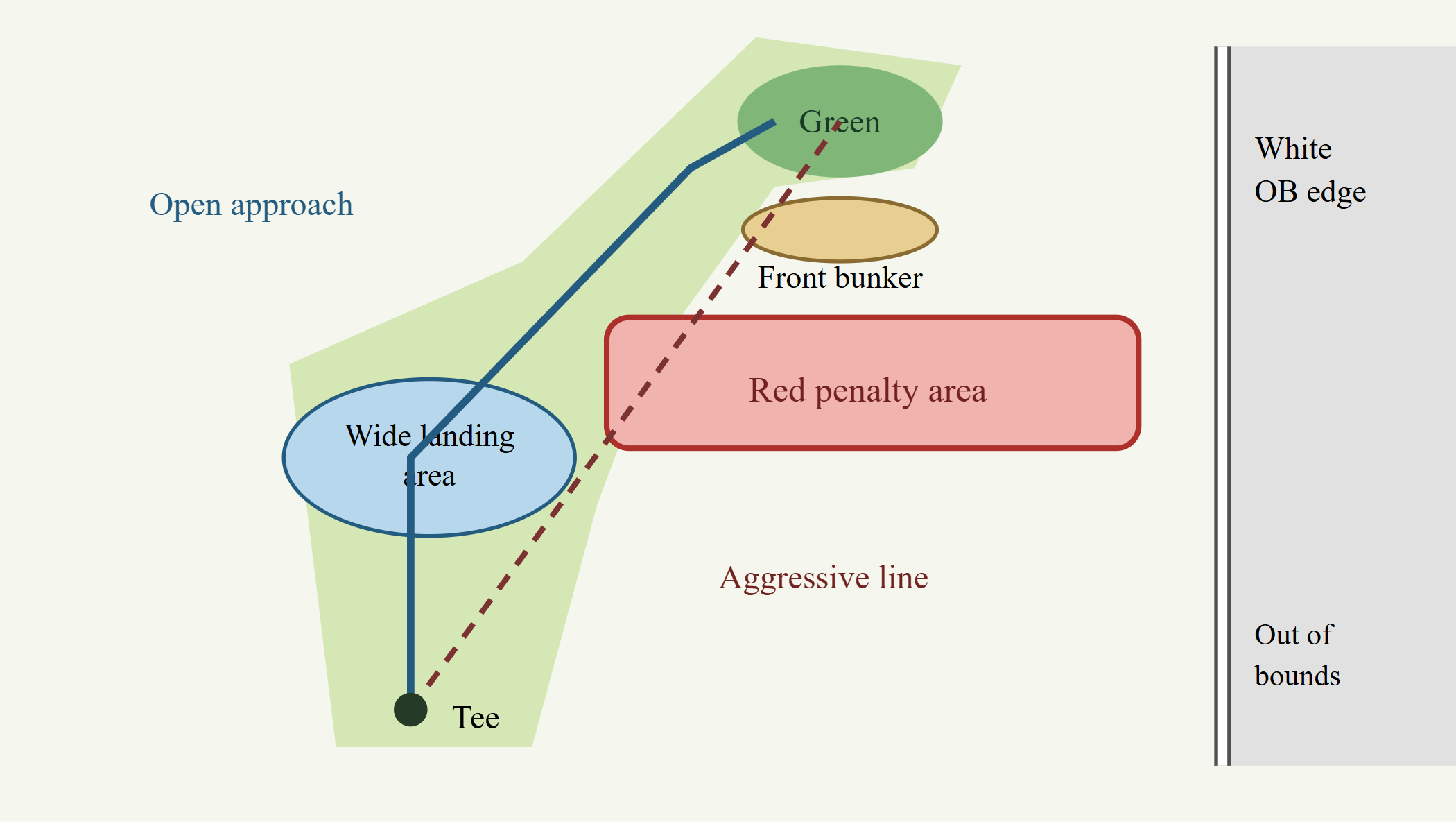
Keep the consequences separate. Relief from a red penalty area carries one penalty stroke under Rule 17.1d. Out of bounds normally requires stroke-and-distance relief under Rule 18.2b. That makes the white edge a different planning problem from the red area; neither should be treated as simply “trouble right.”
Compare carry with the clearing target
Carry is the distance the ball travels through the air before first landing. Use carry when evaluating a forced crossing; total distance includes movement after landing and cannot establish whether the ball clears an obstacle. See Trackman’s explanation of carry.
Build the decision around measured carry by club. Look at the spread of ordinary shots, including the shorter ones, rather than selecting your longest result. Then consider whether wind and lie make that pattern applicable. A clean fairway strike and a ball sitting down in rough may require different choices, even at the same distance.
| Reference | What it tells you |
|---|---|
| Distance to the front | Where the green or obstacle begins. It does not establish clearance. |
| Distance to a clearing target | The carry needed to land safely beyond the obstacle’s far edge, with room for ordinary variation. |
A front-of-green number alone does not prove you can carry the bunker. Identify its far edge and a useful landing point beyond it.
Choose a route with the decision tree
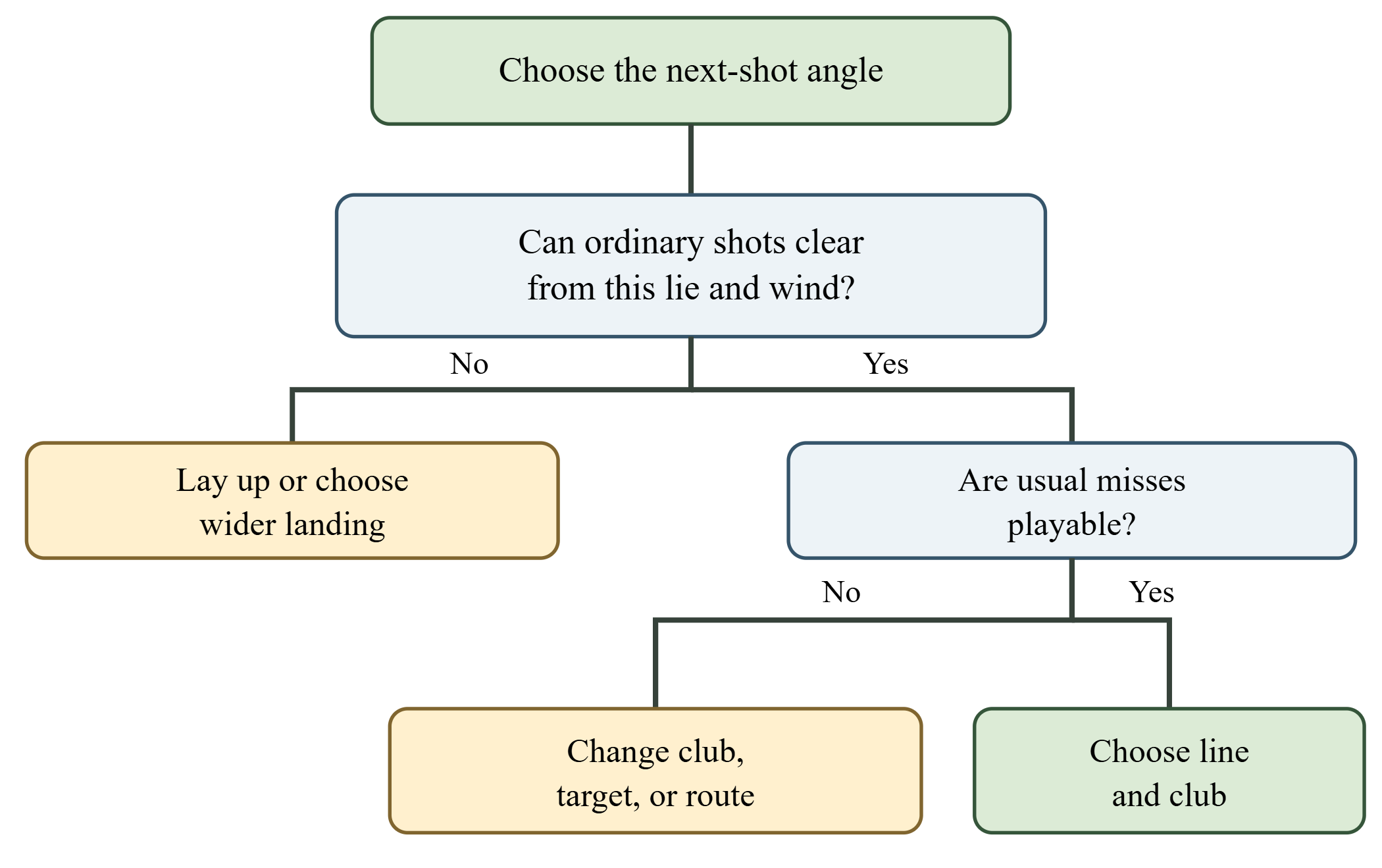
Apply this sequence before committing to the aggressive line. A lay-up means deliberately finishing short of trouble to leave another shot. Choose its landing area with the same care you give an approach.
Handle the borderline carry
Teaching example: Your best strike clears the red area, but ordinary shorter strikes finish inside it. That is a borderline carry, not a dependable crossing. Favor the wide landing area or a lay-up unless another club provides adequate ordinary carry and an acceptable landing spread. Extra distance is useful only if its misses also fit.
Now suppose the same crossing looks reasonable from the fairway, but the ball is sitting down in rough. Fairway and rough belong to the general area under Rule 2.2; their playing conditions can still differ substantially. If your fairway measurements do not support a confident estimate from that lie, the wider route becomes more attractive.
From the open approach, a shorter, higher shot may suit a shallow landing area if its carry clears everything along that line. Height alone does not solve a carry shortage. Keep the decision focused on where the ball must land and what happens when it lands short.
Before swinging, name your landing target, your ordinary short miss, and the next shot each leaves. If the plan depends on matching your best strike, reconsider the club, landing area, or route.