
If your practice swing accidentally moves your ball, the decision depends on where the ball was. Before your first stroke from the teeing area, re-tee without penalty. In the fairway or rough, ordinarily add one penalty stroke and replace the ball. On the putting green of the hole you are playing, replace it without penalty.
These rulings apply the USGA/R&A 2023 edition of the Rules of Golf. The examples below assume accidental contact during a genuine practice swing.
First, was it actually a stroke?
A stroke is the forward movement of the club made to strike the ball. If you try to hit the ball and swing through but miss, that counts as a stroke. Accidental contact during a practice swing is not itself a stroke, although moving a ball in play can bring a penalty. That distinction matters when counting your next shot. See the definition of Stroke and Rule 6.2b(5).
Three positions, three decisions
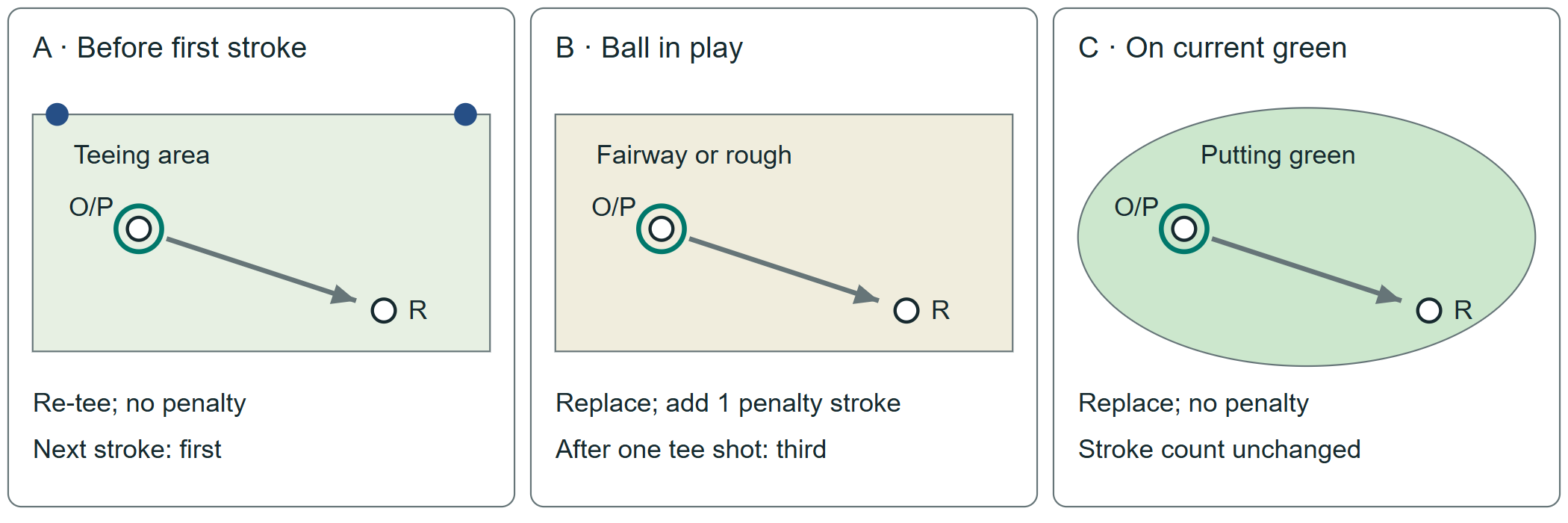
A. Knocked off the tee before starting
You brush the ball off its tee during a practice swing before your first stroke, and it stays within the teeing area. Re-tee it without penalty. You have not started the hole, so your next stroke is your first. Rule 6.2b(5) applies.
B. Accidentally moved after your tee shot
Your tee shot finishes in the fairway or rough. A practice swing then knocks the ball away from its spot. Outside an applicable exception, add one penalty stroke and replace the ball. Your tee shot counts as one, the penalty adds one, and your next stroke is your third. Rules 9.4a–b apply.
C. Accidentally moved on the current putting green
Your practice putting motion accidentally nudges your ball on the putting green of the hole being played. Replace it without penalty. This protection applies even if you had not yet marked or lifted the ball. Rule 13.1d(1) applies.
| Scene | Strokes already made | Penalty strokes | Next stroke |
|---|---|---|---|
| A: before starting | 0 | 0 | First |
| B: after one tee shot | 1 | 1 | Third |
| C: reached green in two | 2 | 0 | Third |
What “replace” means
For B and C, set the original ball down by hand on its original spot. Estimate that spot if you do not know it exactly. Do not drop the ball or simply play from the accidental resting spot. The replacement procedure is in Rules 14.2b–c.
Check what caused the movement
Searching: Accidentally moving a ball while fairly trying to find or identify it carries no penalty, but the ball must be replaced. A routine practice swing is not automatically a search action. Rule 7.4 applies.
Wind: Natural forces normally mean no penalty and playing from the new spot. One important exception: if a ball on the putting green had already been lifted and replaced, replace it when wind moves it. See Rules 9.3 and 13.1d(2).
Movement during an intended stroke: If the ball starts moving after you begin the stroke or its backswing and you complete the stroke, play from where the ball finishes afterward. Any penalty for causing movement is considered separately. This is a different situation from a completed practice swing. See Rules 9.1b and 9.4b.
Self-test: two changed facts
1. You whiff your opening tee shot, then accidentally knock the ball off the tee during a practice swing. It stays in the teeing area. What comes next?
Answer: Re-tee without an additional penalty. The whiff counted, so your next stroke is your second. Rules 6.2b(5)–(6).
2. While fairly searching in rough, you accidentally move your ball with your foot. Is the fairway practice-swing penalty appropriate?
Answer: No. Replace the ball without penalty, estimating its original spot if necessary. The search exception applies under Rule 7.4.