
Choose wedge bounce by matching the sole to your usual lies and the way you strike the ground. Firm turf and packed sand often favor less bounce; soft turf and fluffy sand often favor more. A steep delivery generally needs more protection against digging than a shallow delivery. When those clues conflict, compare clubs on your actual short shots before choosing.
The stamped bounce number is a starting point. Sole width, grind, shaft position, and face position also influence how the club meets the ground. Understanding those differences makes the choice more useful than simply buying “high” or “low” bounce.
Loft, bounce, and grind describe different things
Loft describes the angle of the clubface relative to vertical in its reference position. It helps establish the club’s potential launch and distance, although delivery and contact affect the shot.
Bounce describes the sole’s reference angle relative to the ground. In simplified side-view geometry, the leading edge sits above the sole’s lowest contact point. That arrangement helps the sole resist digging. The leading edge is the bottom front edge of the clubface. Vokey’s wedge bounce explanation connects bounce selection with turf, sand, and delivery.
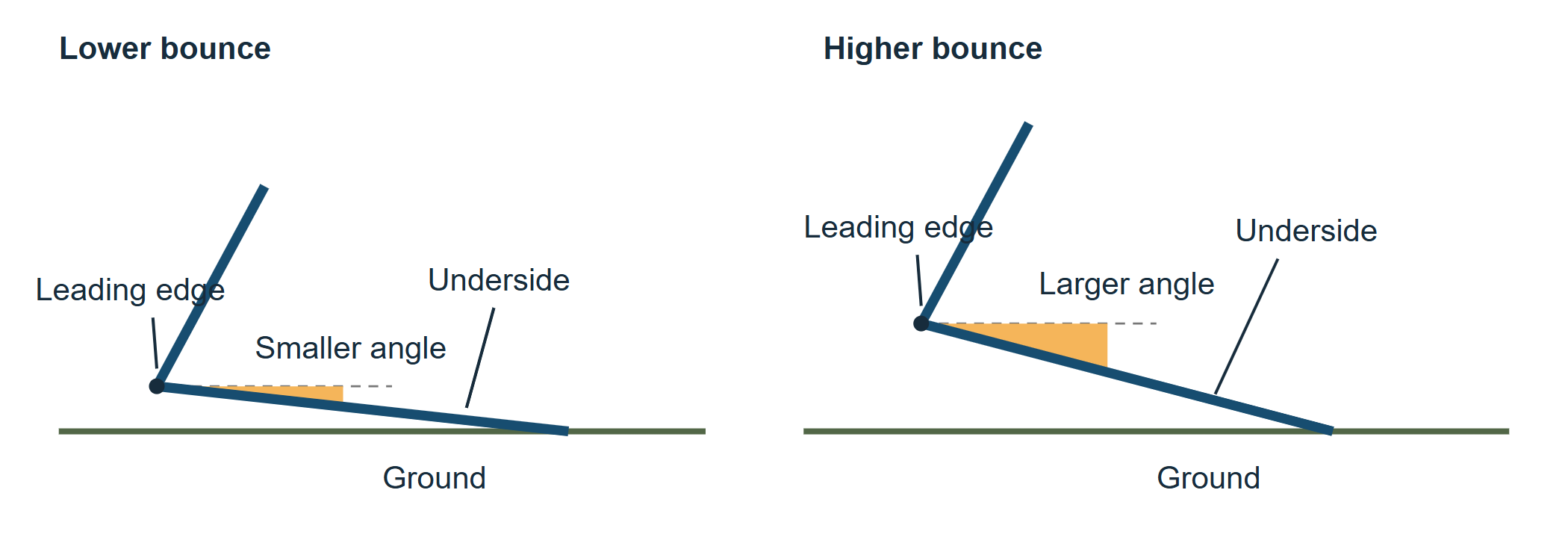
Grind is the sole’s three-dimensional shaping, including material relieved around the heel, toe, or trailing edge. Two wedges with the same loft and stamped bounce can behave differently because their soles have different widths, curves, and relief.
Match conditions with your delivery
Read the lie and your delivery together. A shallow swing brushes the ground; a steep swing enters it more sharply. Neither automatically determines the best wedge.
| Conditions and delivery | Useful starting point | What to watch |
|---|---|---|
| Firm, tight turf or packed sand; shallow delivery | Lower bounce or a sole that sits close to the surface | The leading edge must reach the ball without the sole rebounding first. |
| Soft turf or fluffy sand; steep delivery | More bounce and potentially a wider sole | Enough support to resist excessive digging. |
| Firm turf; steep delivery | Compare moderate bounce and different sole shapes | Too little support can still dig; more bounce needs suitable presentation. |
| Soft conditions; shallow delivery | Compare sole width as well as bounce | Useful flotation without repeatedly catching the ball thin. |
| Mixed lies and deliveries | A middle-bounce option with versatile relief | Which routine shots become easier and which become harder. |
Face position changes the sole you present
Opening the face commonly presents more bounce and raises the leading edge. Forward shaft lean commonly reduces the bounce presented. Closing the face also changes presentation, with the result depending on the sole shape and shaft position. These movements do not change the stamped reference angle.
Heel and trailing-edge relief can help an opened wedge sit closer to the ground. Relief also removes supporting material, so a versatile shape for firm lies may offer less help in soft sand. Vokey’s loft, bounce, and grind explanation describes how these design features work together.
Teaching example: A steep-swinging golfer plays firm fairways and fluffy bunkers. A lower-bounce wedge might sit comfortably on the fairway but dig in the bunker. A higher-bounce alternative might help in sand while requiring more careful presentation on tight turf. This illustrates a tradeoff, not a tested result or a universal winner.
Original reader aid: compare two wedges fairly
- Use wedges with the same or very similar loft. Choose a permitted practice area, a clear landing target, and short shots you can control safely.
- Alternate wedges from equivalent lies. Keep the target, intended trajectory, and swing length consistent. Use fresh, comparable patches of turf or reset the sand between shots.
- Start with a square face. If you use closed-face or open-face shots, compare each setup separately with both wedges. Keep face position and shaft lean as consistent as possible within each comparison.
- Record strike quality and ground interaction: solid or thin contact, shallow brushing or deep digging, and smooth passage or noticeable rebound. Repeat across several shots before drawing a conclusion.
Choose the sole that supports your common shots with repeatable contact. If the results remain mixed, bring those observations to a wedge fitting and compare grind and sole width alongside bounce.
Sources
- Vokey: Wedge Bounce.
- Vokey: Wedge Loft, Bounce and Grind.