
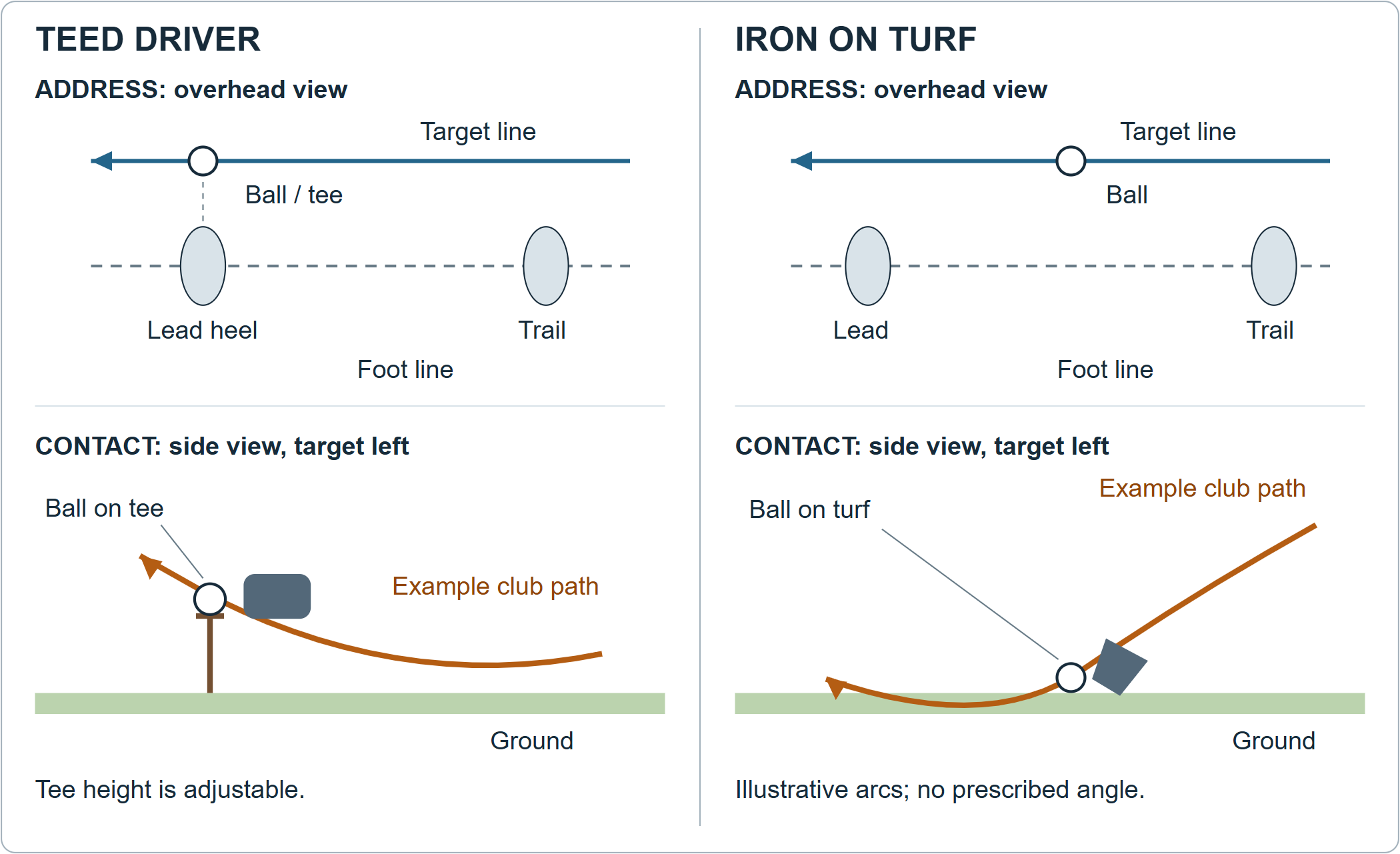
Start by changing the conditions at address: tee the ball, position it near your lead heel, and make easy swings while checking where the ball meets the face. A driver strikes a ball supported above the ground; an iron usually strikes a ball resting on turf. That difference changes the contact you are trying to produce.
These golf driver swing basics give you starting checks, not one mandatory position. Use both strike location and shot direction to decide whether a setup change helps.
Build an address you can repeat
For a right-handed player, the left side is the lead side, toward the target. Left-handed players should mirror the illustration and instructions.
Begin with the ball approximately opposite your lead heel. Adjust the tee so the ball sits comfortably above the ground for your driver, then keep that height consistent during your first group of shots. There is no single tee height that guarantees good contact.
Your trail hand sits lower on the grip, so allow the trail shoulder to sit modestly lower, too. Avoid exaggerating that tilt or leaning farther back during the swing. Treat these as comfortable starting relationships, consistent with the supplied driver instruction.
Separate the target line—the direction you intend to start the ball—from the foot line across your stance. Aim the clubface first, then check your feet. The parallel lines below are a reference. Keep alignment sticks for range practice: setting down an object to help aim, take a stance, or swing during a round breaches Rule 10.2b(3), even if you remove it before the stroke.
Change the contact task
With an iron on turf, the usual goal is to meet the ball before the ground, with the bottom of the swing occurring beyond the ball toward the target. That ball-first relationship underpins the supplied iron-play fundamentals.
The teed driver gives you room to contact the ball above the ground. You do not need to reproduce an iron divot, and you should not try to lift the ball by scooping with your hands. An upward strike can suit a driver, but a fixed upward angle is not a universal requirement. Look for repeatable contact and a useful flight.
Use five easy swings to make one decision
Judge the groups together. A longer shot does not settle the question if contact becomes scattered or the group spreads wider. Repeat a promising setup before treating it as your new starting point.
| Face observation | Useful response |
|---|---|
| Heel or toe contact | Record the pattern and recheck your address. The mark alone does not identify its cause. |
| High or low contact | Record the pattern before comparing one small tee-height adjustment. Keep ball position unchanged. |
Teaching example: Suppose a higher tee produces more centered marks but a wider shot group. That is mixed feedback. Repeat both heights before choosing; the example illustrates a decision, not a practical test result.
Choose your next practice step
If contact and direction improve together, keep that setup and gradually return to your normal effort. If strikes remain scattered, stay with easy swings and verify that your starting position is consistent. When centered contact repeatedly sends shots away from your target, a lesson can help separate face direction and club path from setup guesses.