
Golf terminology helps you answer two practical questions: where is my ball, and what should I do next? Before choosing a club, check the ground around your ball and any marked boundary. Rough usually means planning a tougher shot. A red penalty boundary or white out-of-bounds boundary can change your options and your score.
Course and field terms
Picture a hole as a route from the teeing area to the putting green. The diagram shows common features along that route, with a penalty area beside the fairway and an out-of-bounds boundary beyond the green.
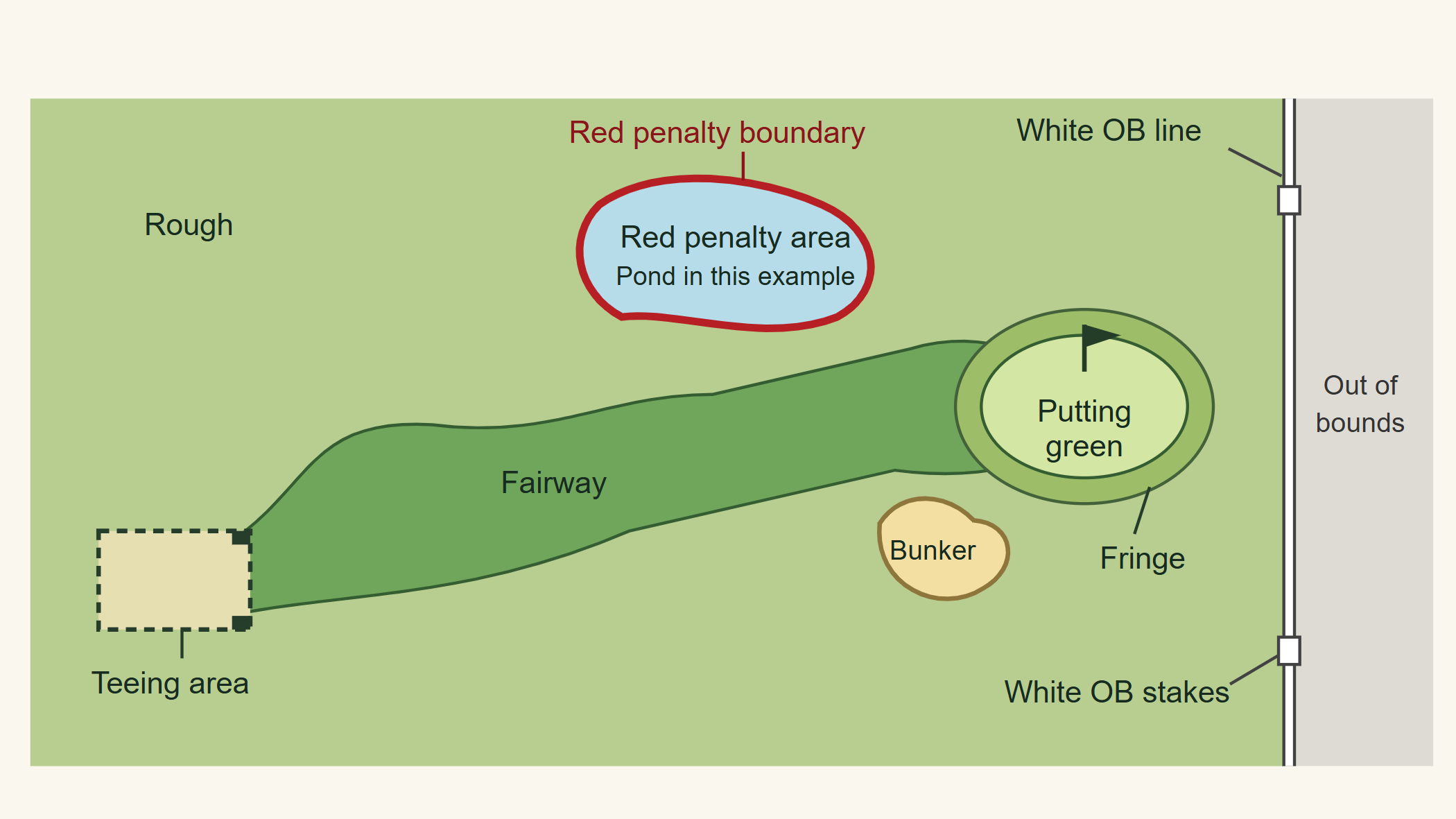
Text legend for the teaching hole:
- Teeing area
- The starting rectangle defined by the tee-markers, extending two club-lengths backward. Your ball must start within this area (Rule 6.2b).
- Fairway and rough
- Fairway is closely mown grass along the intended route; rough is longer grass beside it. Both are typically part of the general area (Rule 2.2).
- Bunker
- A specially prepared area of sand, with restrictions on touching sand before a stroke (Rule 12.2b).
- Putting green
- The area specially prepared for putting on the hole you are playing, a distinct course area under Rule 2.2.
- Fringe
- The collar of grass around the green. It is typically general area, even when the grass is short (Rule 2.2).
- Red penalty boundary
- The marked edge of a red penalty area. Here it surrounds a pond; penalty areas can also contain other terrain (Rule 17.1).
- White OB line or stakes
- Markers defining out of bounds. A ball is out only when all of it is outside the course boundary (Rule 18.2a).
Avoid calling every difficult place a “hazard.” The Rules distinguish the general area, bunkers, penalty areas, the teeing area for the hole, and its putting green. Those names matter because different rules apply (Rule 2.2).
Strokes, par, and scores
A stroke is the forward movement of the club made to strike the ball. Trying to hit it and missing can still count as a stroke (Rules of Golf, Definition of Stroke). Your hole score includes strokes made and applicable penalty strokes.
Par is the score an expert player is generally expected to make on a hole. On a par 4, a score of 4 is par, 3 is a birdie, and 2 is an eagle. A 5 is a bogey; a 6 is a double bogey. These names describe your score relative to par.
Club names describe useful tools for the route. A driver commonly supplies distance from the tee on longer holes. An iron often plays an approach—a shot toward the green. A wedge suits many shorter shots and bunker shots, while a putter rolls the ball toward the hole. These are typical uses, not boundaries restricting where each club may be used.
Turn a boundary sign into an action
Teaching example: You see a “Red penalty area” sign beside the pond. First find the red line or stakes defining its edge, then locate your ball. A ball lying entirely in rough outside that boundary remains in the general area. If any part touches the red boundary line, it is in the penalty area (Rule 17.1a). You can consider playing it as it lies without penalty or taking an available relief option for one penalty stroke (Rule 17.1b–d).
| What you find | Term and next action |
|---|---|
| Ball in rough or on fringe | Typically general area. Assess the lie and choose your shot; proximity to the green does not change the area (Rule 2.2). |
| Ball in a bunker | Check the sand-touching restrictions before preparing your stroke (Rule 12.2b). |
| Ball in the red penalty area | Compare playing it as it lies with one-penalty-stroke relief. Red areas offer a lateral relief option; consult the full procedure before dropping (Rule 17.1d). |
| Ball wholly out of bounds | Under the standard rule, add one penalty stroke and play from where the previous stroke was made: stroke-and-distance relief (Rule 18.2b). |
Use the map to name the situation, then consult the applicable relief procedure when needed. Knowing the term gets you to the right decision; the full rule supplies the dropping location and conditions.
Sources
Rule 2: The Course; Rule 6: Playing a Hole; Rule 12: Bunkers; Rule 17: Penalty Areas; Rule 18: Stroke-and-Distance, Lost Ball and Out of Bounds; Rules of Golf and Definitions.