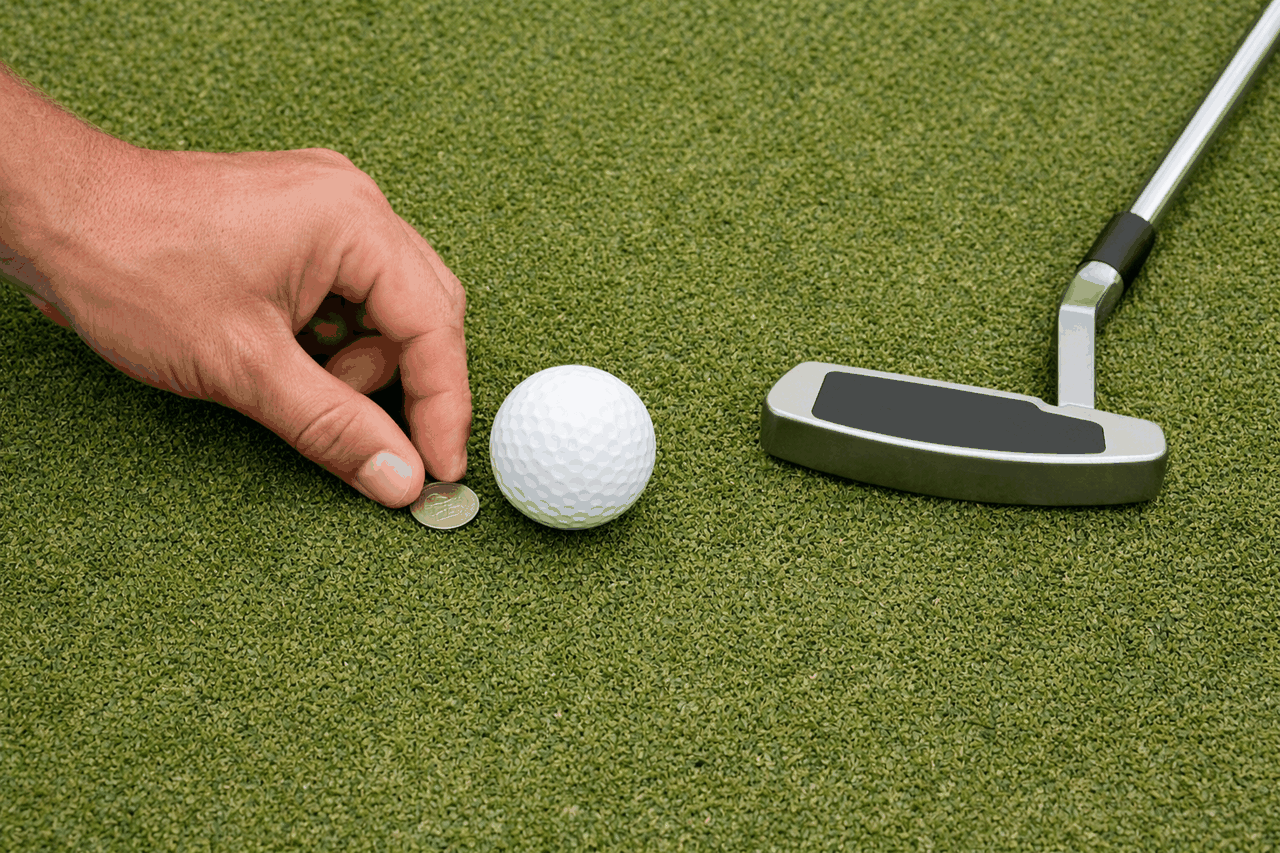
On the putting green for the hole you are playing, mark your ball before lifting it, clean it if needed, then replace it on its original spot and remove the marker. You may repair specified damage, but you cannot smooth away every imperfection or deliberately test the surface.
A ball touching this green is on it. The fringe is generally part of the general area, so the green’s special permission to lift and clean does not automatically apply there (Rule 13.1a–b).
Mark, lift, clean and replace
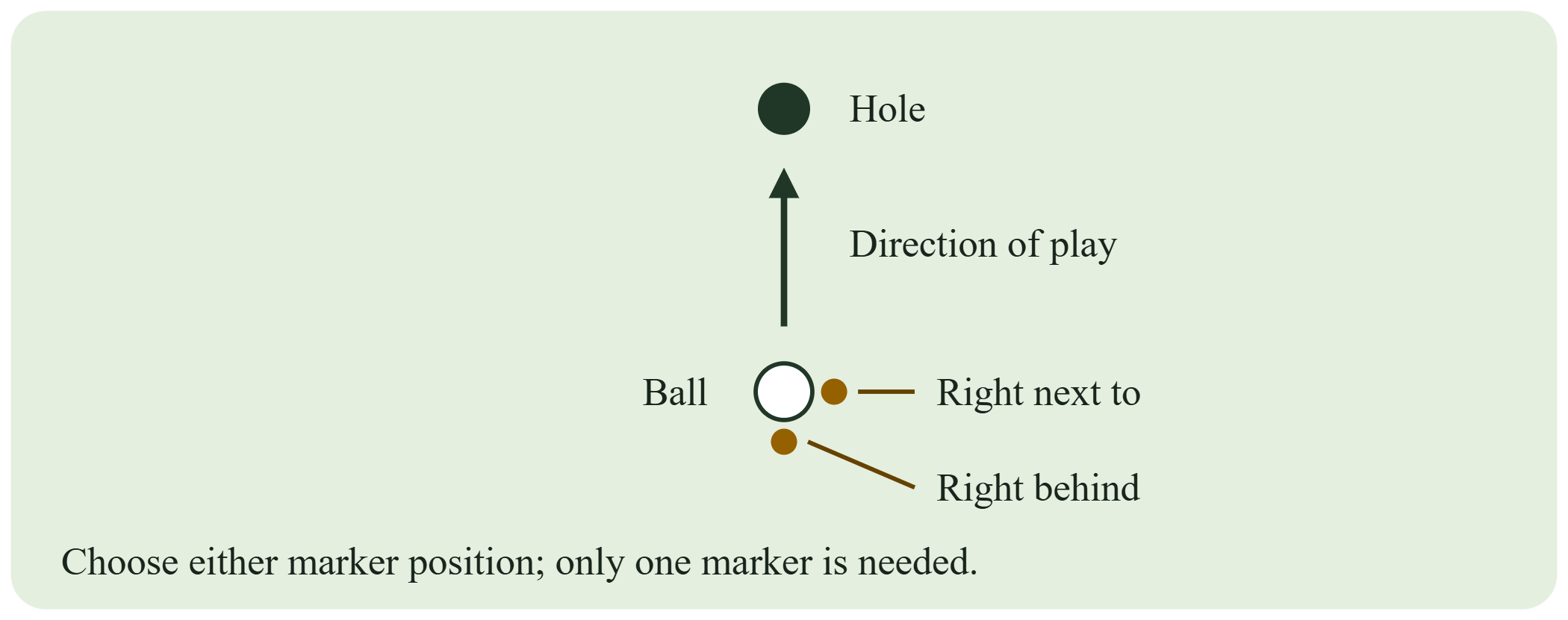
Place a ball-marker—a small artificial object such as a coin—right behind or right next to the ball. A club held on the ground right behind or right next to it also works. Mark before lifting, then replace the ball on its original spot; if that spot is unknown, estimate it. Remove the marker before making a stroke. Lifting without first marking, or making a stroke with the marker still in place, carries one penalty stroke (Rules 14.1a and 14.2c).
Repair damage without testing
You may repair ball marks, spike marks, animal tracks and old hole plugs. Use reasonable actions to restore the green as nearly as possible to its original condition, without unreasonably delaying play. Aeration holes, vertical-mowing grooves and natural imperfections, such as uneven grass growth, are excluded from this permission (Rule 13.1c(2)).
Repair is different from testing. Do not deliberately roll a ball or rub the current green to find out how its surface plays (Rule 13.1e).
Choose your next action
Rules edition: This guide follows the 2023 USGA and R&A Rules of Golf, effective January 1, 2023. The USGA’s October 2026 clarifications still identify that edition.
| Situation | Next action | Rule |
|---|---|---|
| You want to clean a ball on this green | Mark, lift, clean, replace on the original spot, then remove the marker. | 13.1b; 14.1–14.2 |
| Qualifying damage, such as a ball mark | Repair reasonably to restore the original condition. | 13.1c(2) |
| Natural imperfection or routine maintenance hole | Leave it alone; the damage-repair permission does not cover it. | 13.1c(2) |
| Someone accidentally moves your ball or marker on the green | Replace it on its original spot without penalty. If the ball begins moving during your backswing or stroke and you make the stroke, play it as it lies after the stroke instead; if you do not make the stroke, replace it without penalty. | 13.1d(1); 9.1b |
| Wind or another natural force moves your ball before it has been lifted and replaced | Play from its new spot. | 13.1d(2) |
| Wind or another natural force moves your ball after it has been lifted and replaced | Replace it on its original spot without penalty. | 13.1d(2) |
Teaching example: You mark, lift, clean and replace your ball. Wind then blows it a foot away before you putt. Replace it without penalty: the earlier lift and replacement determines the ruling. For accidental contact during a rehearsal swing, see practice swing scenarios.
Keep helpers clear of your aim
From when you begin taking your stance until you make the stroke, your caddie must not deliberately stand on or close to the extension of your line of play behind the ball to help you aim. To correct this before playing, back away and have the caddie move away before you begin taking your stance again. These restrictions also extend to partners and their caddies in partner formats (Rule 10.2b(4)).
Another player simply standing behind you does not automatically create that caddie violation; asking them to move if distracting is etiquette. During the stroke, you must not receive physical help or have a person or object deliberately positioned to eliminate distractions or protect you from the elements (Rule 10.2b(5)).
Choose what happens to the flagstick
Before putting, choose whether to leave the flagstick in, remove it, or have someone attend it and remove it as the ball approaches. An ordinary, unintentional hit on a flagstick left in the hole carries no penalty; play the ball as it lies (Rule 13.2a). With an attended flagstick, the attendant should remove it so the moving ball does not strike it (Rule 13.2b).
A ball resting against the flagstick is holed when any part is below the putting green’s surface. If none is below the surface, it is not holed (Rule 13.2c).
Sources
The R&A, Rules of Golf: Rule 13: Putting Greens; Rule 14: Procedures for Ball; Rule 10: Advice and Other Help.