
Before moving your golf ball, identify where it lies. A ball in the rough, a bunker, a penalty area or out of bounds can require different decisions. In ordinary stroke play, start from the teeing area, play the ball as it lies unless a rule allows another action, and finish by holing out. Your score includes strokes made and penalty strokes.
Play a hole from tee to green
Begin in the teeing area for the tees you are playing. Put your ball inside that area; do not move the tee-markers to make the shot easier. Rule 6 governs starting and playing a hole.
After your tee shot, find and identify your ball. If it is sitting in the fairway or ordinary rough, your starting point is to play it where it rests. Longer grass does not, by itself, give you a free move to shorter grass. Fairway and rough belong to the general area, the course area that excludes the hole’s teeing area and putting green, bunkers and penalty areas.
On the putting green, you may mark the ball’s spot, lift and clean it, then replace it on its original spot without penalty. Mark before lifting. This permission does not automatically extend to a ball beside the green. The separate guide to putting green rules explains the next choices under Rule 13.
Continue until your ball is holed. In ordinary stroke play, a playing partner’s offer to concede a short putt does not finish your hole. Record strokes made plus penalties, as required by Rule 3.
Use the same hole as a decision map
Locate your situation on this teaching hole, then use the table. The red boundary marks a penalty area; the white stakes mark out of bounds. Those markings lead to different rules.
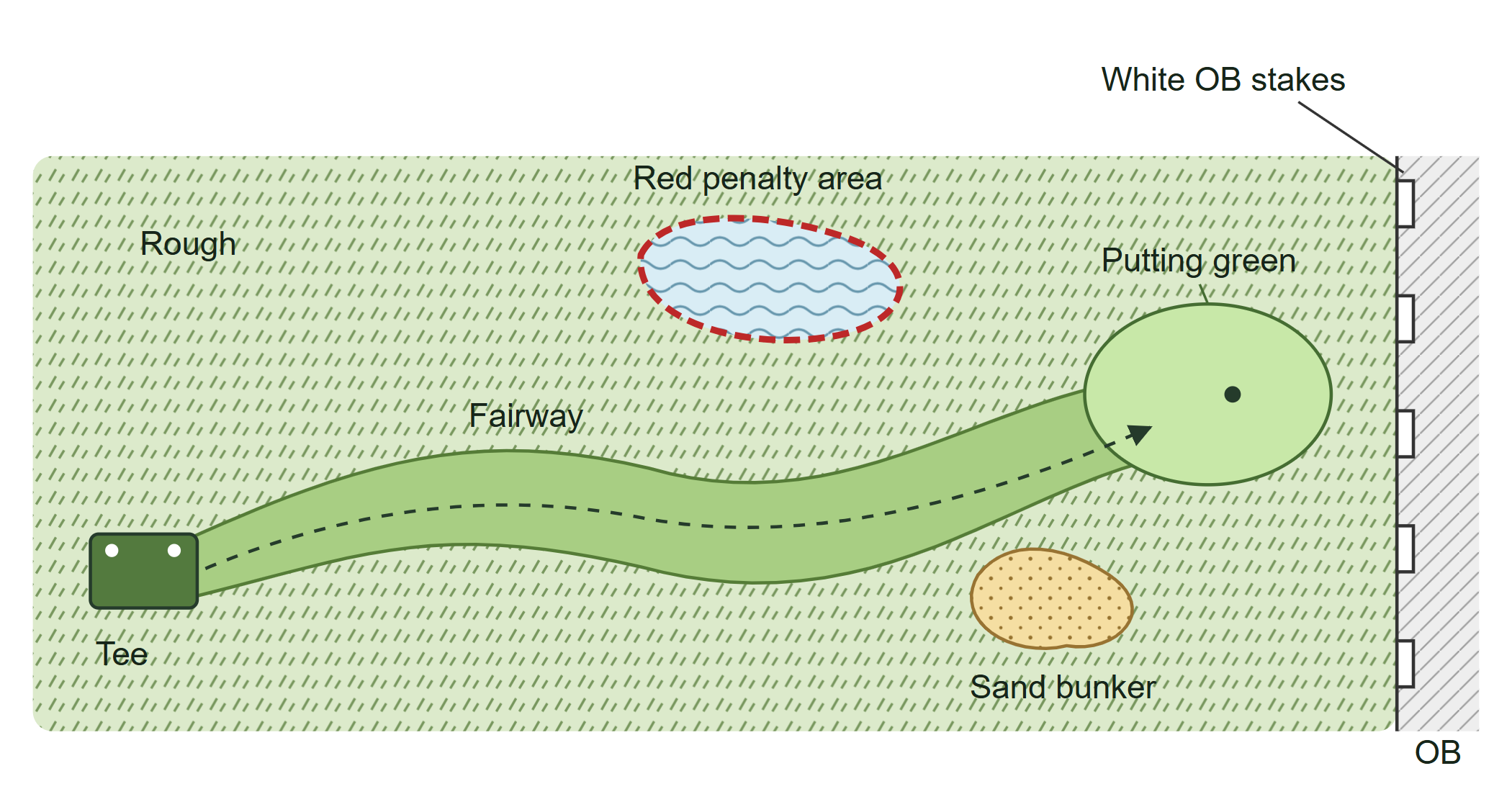
Stroke-and-distance means adding one penalty stroke and playing again from where the previous stroke was made. It does not mean dropping beside the place where the ball disappeared.
| Area or evidence | Applicable rule | Action | Penalty cost |
|---|---|---|---|
| Ball found in fairway or ordinary rough | Rule 1 | Play as it lies unless another rule allows relief. | None merely for being there. |
| Ball in a red penalty area, or known or virtually certain to be there | Rule 17 | Play as it lies if allowed, or choose stroke-and-distance, back-on-the-line or lateral relief. | No penalty to play as it lies; one stroke for a listed relief option. |
| Ball in a yellow penalty area, or known or virtually certain to be there | Rule 17 | Play as it lies if allowed, or choose stroke-and-distance or back-on-the-line relief. No standard lateral option. | No penalty to play as it lies; one stroke for a listed relief option. |
| Ball missing in ordinary rough after the three-minute search time, without grounds for another rule | Rule 18 | Take stroke-and-distance relief. | One stroke, plus replaying from the previous location. |
| Ball wholly outside the course boundary | Rule 18 | Take stroke-and-distance relief, even if you find the ball. | One stroke, plus replaying from the previous location. |
| Ball lying in bunker sand | Rule 12 | Play from the bunker, observing its sand restrictions. | None merely for being in the bunker. |
A shot heading toward water is not automatically evidence that the ball finished in a penalty area. If the ball is lost without virtual certainty that it came to rest in a penalty area, Rule 18 applies unless another specific exception is established. For exactly where to drop, use the separate guide to penalty areas and Rule 17 relief. See Rule 12 for the sand restrictions.
Count the replay correctly
Suppose your first tee shot finishes out of bounds. Count that first stroke, add one penalty stroke, and play again from the teeing area. Your next stroke is stroke three. The replay itself is another stroke, separate from the penalty.
The separate guide to lost ball or out of bounds explains when a provisional ball can save time under Rule 18.