
If your ball is lost outside a penalty area or wholly out of bounds, the standard answer is stroke-and-distance: add one penalty stroke and play again from where you made the previous stroke. A provisional can save the walk back; an adopted Local Rule E-5 can provide a different option. Start by establishing which situation applies. (Rule 18.2b.)
These rulings use the 2023 edition of the USGA and R&A Rules of Golf, including Model Local Rule E-5 when adopted.
Check the boundary before picking up
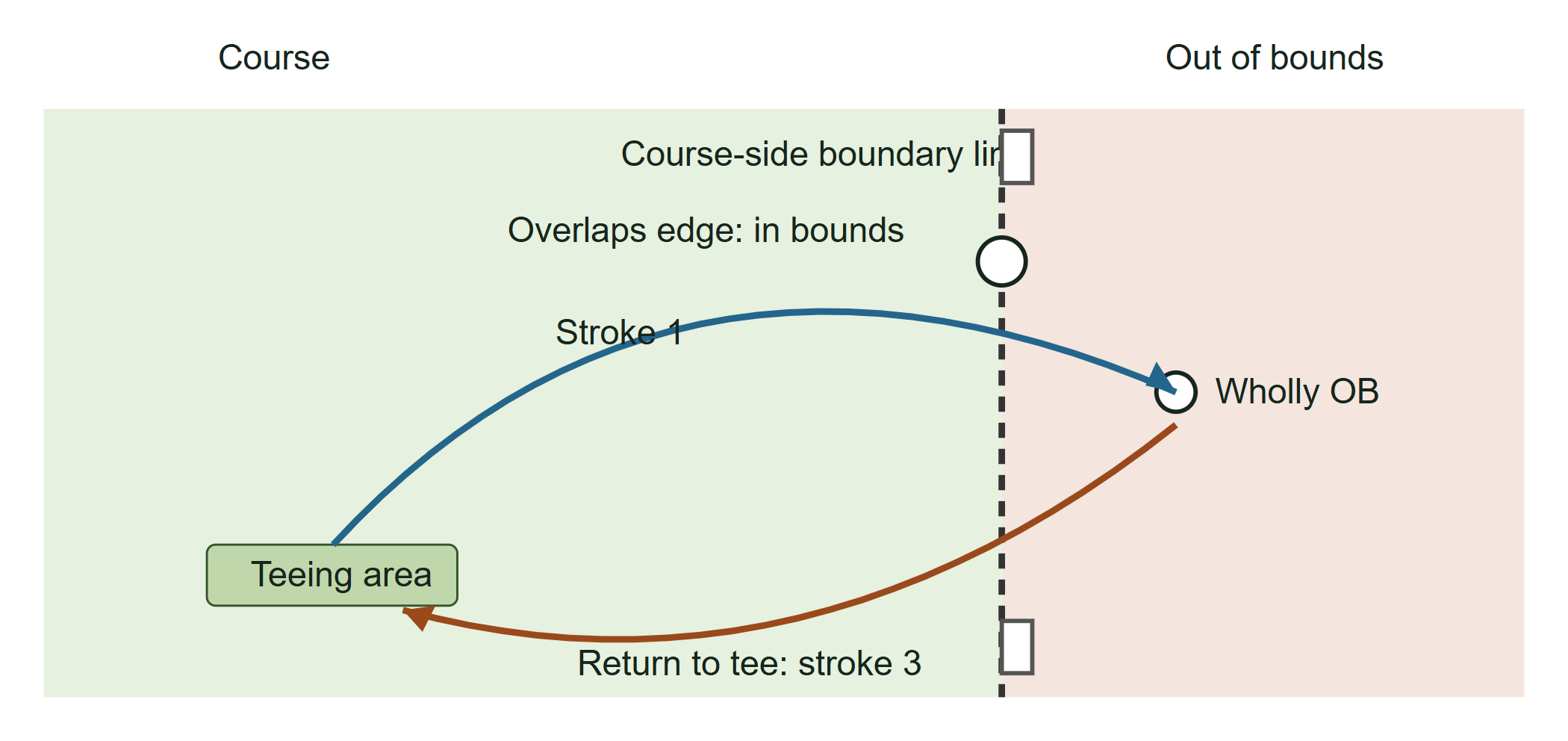
A ball is out of bounds only when all of it is outside the boundary edge. Any part above that edge or inside the course keeps it in bounds. When stakes define the boundary, use the line between their course-side points at ground level. Boundary fences normally use the course-side points of their posts at ground level; follow any different definition specified by the Committee. (Rule 18.2a(2); Definition of Out of Bounds.)
Use the three-minute search correctly
The clock starts when you or your caddie begins searching. If the ball is not found within three minutes, it is lost. If found in time, promptly identify it: the Rules allow reasonable additional time to reach the ball and confirm that it is yours. Finding an unidentified ball does not restart the search clock. (Rule 18.2a(1).)
Replay from the right place—and count every stroke
| Previous stroke location | Replay procedure |
|---|---|
| Teeing area | Play from anywhere within that teeing area; you may tee the ball. (14.6a.) |
| General area | Drop within one club-length of the estimated previous spot, no nearer the hole, staying in the general area. (14.6b.) |
| Putting green | Place a ball on the previous spot, estimating it if necessary. (14.6c.) |
Teaching example—tee shot OB: Your drive finishes beyond the white fence. The drive counts as stroke one; the penalty adds stroke two. Your next stroke from the teeing area is your third. (Rule 18.2b.)
Teaching example—second stroke lost in rough: Your second shot disappears, and the search expires. Count that stroke, add one penalty stroke, and return to its previous location. If you played from the general area, use the drop described above. Your next stroke is your fourth. (Rules 18.2b and 14.6b.)
Make your provisional unmistakable
Before playing, say “provisional” or otherwise clearly indicate that status; “I’m hitting another” is insufficient. Normally, announce and play it before going forward to search. Rule 18.3a also permits a provisional after searching begins, while search time remains. A provisional is allowed when the original might be out of bounds or lost outside a penalty area. Possible loss only in a penalty area does not qualify. (Rules 18.3a–b.)
You may continue playing the provisional from spots equally distant from, or farther from, the hole than the original’s estimated location. It becomes your ball in play when the original is lost outside a penalty area or OB, or when you play the provisional from nearer the hole than that estimated location. If the original is found in bounds in time before that happens, abandon the provisional. A ball known or virtually certain to be in a penalty area follows Rule 17. (Rules 18.3c and 17.1c.)
Local Rule E-5: the two-stroke alternative
Check the scorecard or competition’s Local Rules first. E-5 applies only if adopted. It permits relief for a lost or OB ball with two penalty strokes; after one tee shot, your next stroke is your fourth. You cannot use it for the original ball after playing a provisional for that ball, or when the ball is known or virtually certain to be in a penalty area. (Model Local Rule E-5.)
Estimate these two reference points:
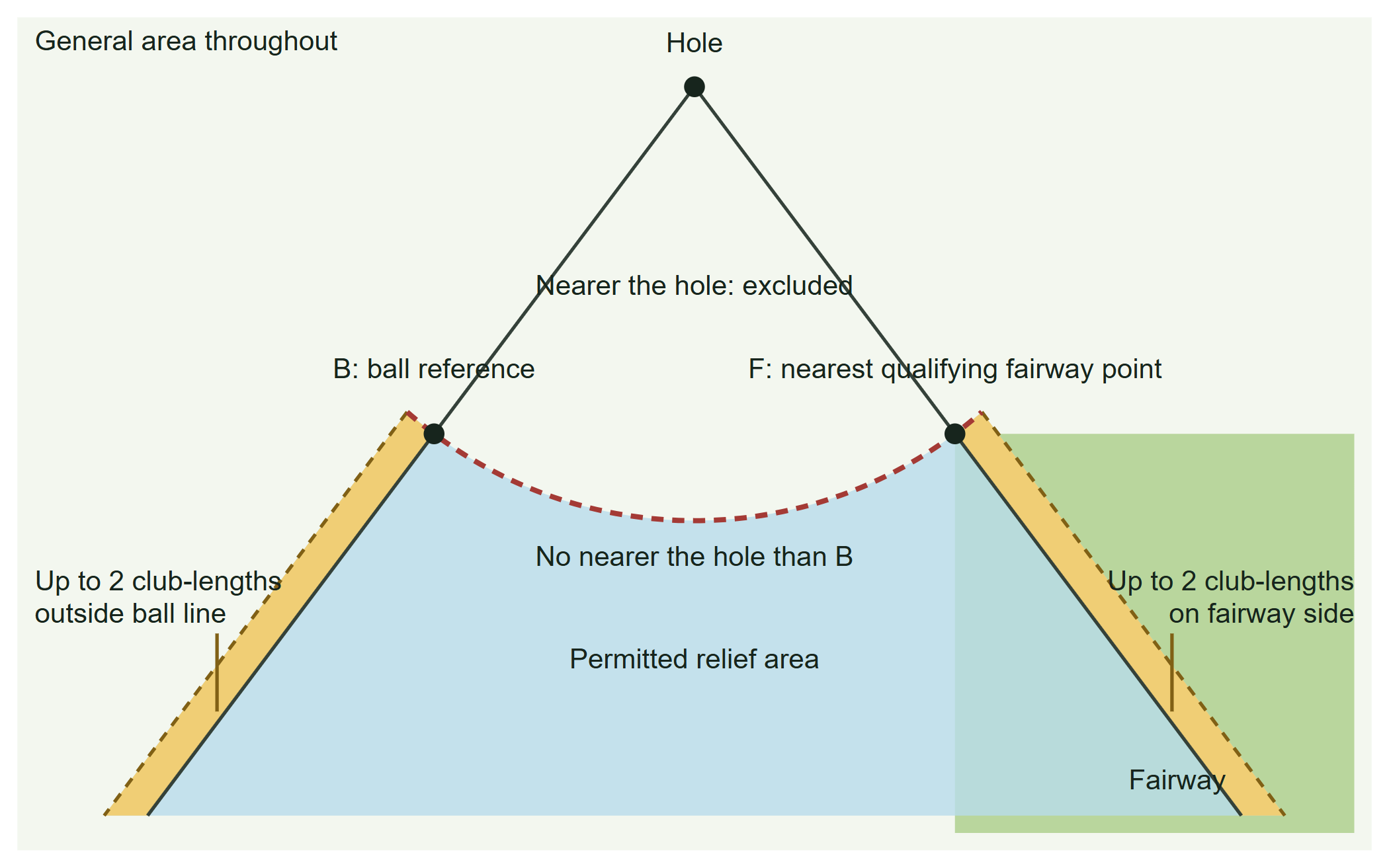
- B—ball reference point: where the ball came to rest on the course, or where it last crossed the boundary to go OB.
- F—fairway reference point: the point in the fairway of the hole being played nearest B, but no nearer the hole than B. Here, “fairway” means grass in the general area cut to fairway height or less. When B is short of the fairway, a grass path or teeing ground for that hole cut to that height may supply F.
The relief area lies between the line from the hole through B, including up to two club-lengths outside that line, and the line from the hole through F, including up to two club-lengths on its fairway side. It must be in the general area and no nearer the hole than B. Drop the original ball or another ball under Rule 14.3. (Model Local Rule E-5.)
Sources
R&A: Rule 18; Rule 14; Rule 17; Committee Procedures, Section 8: Model Local Rule E-5.